Placemaking, a new way of designing and using public space
byIn recent years the need has been strongly felt to design public spaces with greater participation through the involvement of local communities. These are however somewhat isolated cases of design methods not wholly relevant to architects and the decision-making figures in charge, concentrated mostly on the performance phase and little concerned with the next step, i.e. management of these spaces.
This new approach, known as placemaking (or place management) was theorised in the USA as early as 1975 by the New York association Project for Public Spaces and is today a popular movement in designing public spaces with a view to making them the nerve centre of regeneration schemes in cities. The method concentrates on collaboration between public and private stakeholders in order to create quality places which can encourage well-being in people, whether parks, urban centres, piazzas, roads, districts, markets or public buildings.
Design work is not therefore unconnected to the needs of users but rather aims at defining flexible spaces which, even with a decidedly low expenditure, can accommodate the most widely differing uses and meet users’ needs, becoming the driving force of some urban areas as well as a formidable point of integration.
Possibly the example of greatest impact is still the transformation which took place in New York where around seventy Business Improvement Districts are active and which deal with transforming urban districts into attractive places not only for those who live there but also for visitors and tourists, without forgetting the interests of companies that operate there.
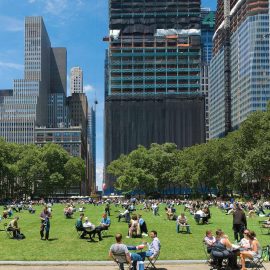
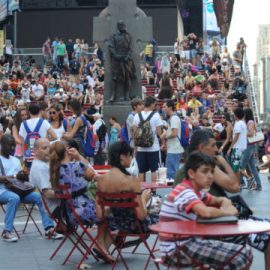
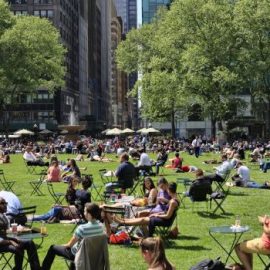
The key to the method is preparation and management via cultural actions. We only have to think of the 5000 green chairs in Bryant Park which then became the symbol of the reclaiming of the public spaces of the city of New York. A challenge which in the past decade, through other schemes (Hudson River Park, Times Square, Herald Square, Union Square, to mention a few) has changed the face of NYC which has today become a green and welcoming city.
This experience clearly explains the mechanisms of governance and shared financial investment, also by private parties, and the types of services which can inspire the programmes of development of the districts and cities of other countries, including Italy. To date the movement is in fact widespread internationally and shared by over 3000 local communities spread across 40 countries.