Along Via Emilia: a journey in pictures 1945-1970
by Lorenzo BazzocchiCast iron excellence coexists with steel
The innovations introduced after the War in the lighting technology field were rapidly taken up by all the main towns and cities along the Via Emilia. Since these are historic cities they already had for some time cast iron street furniture, both lampposts and wall brackets, produced at the start of the twentieth century or even dating back to the second half of the nineteenth century and inspired by the neoclassical style that dominated in that period.
These are in many cases prized pieces, designed ad hoc and cast by important foundries in Italy and elsewhere, the reason why, although these are models by then out of fashion and to be removed in that considered no longer in step with the times, the tendency was to preserve the more significant examples, those types which more than others have contributed in time to identifying and to diversifying the various towns and cities. The only “transgression” consists in the gradual replacement of the lights, by then dated, with newly designed lamps. They are generally tall poles with the top with a corbel or cobra shape, or candelabras with several lights, models which are very familiar to us through having studied and presented them over the years on several occasions in editions of the magazine Arredo & Città.
At this stage a sort of link is formed between the past, represented by cast iron excellence and advancing modernity, a relationship which on the one hand enables the installation new lampposts, looking out onto historical buildings, while, on the other hand, it means that a part still existed of those old models positioned to watch the cars which were by then undisputed masters of town squares. A furnished landscape which we could define hybrid, but which is particularly interesting as centred on the attempt to try out and apply directly in field the results of the new research.
Through the selection of a rich heritage of historic postcards and photos, housed in the archives of Fondazione Neri, we have attempted to reconstruct, on the following pages, the map of the main installations completed in this area between 1945 and the end of the Sixties. This has produced an unusual itinerary whose key feature is the actual objects, modern and functional appliances, considered suitable therefore for transforming the face of lighting in towns and cities born and developed along the great road which founded them.
-
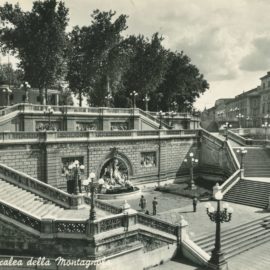
- Bologna, Scalea della Montagnola, anni ’60
-
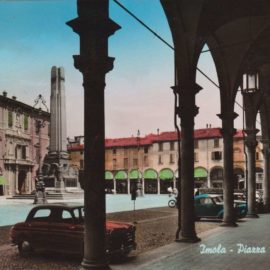
- Imola, Piazza Matteotti, 1960
-
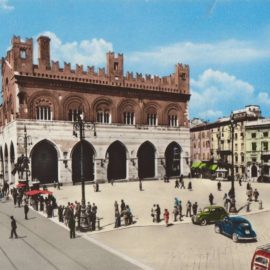
- Piacenza, Piazza Cavalli, 1959
-
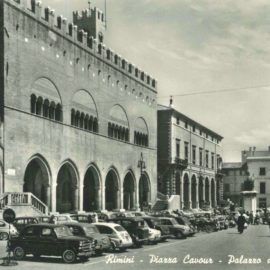
- Rimini, Piazza Cavour, 1964
-
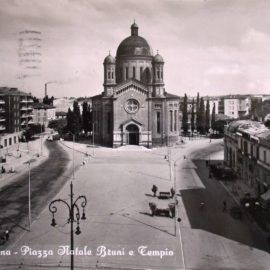
- Modena, piazza Natale Bruni and Monument to the Fallen, 1955
-
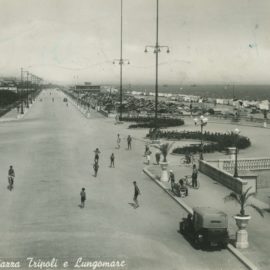
- Rimini, Piazza Tripoli and promenade, 1952
Suspension lamps (using wall or pole suspension)
Research has confirmed how in Emilia too suspension lamps on thermoplastic cables represent the solution most widely adopted during the period in question for lighting in town and city centres, in the same way as on long avenues which now link up the city or town “within the walls” to the new urban developments outside. The lamps have a main part in cast aluminium to which a light bulb in transparent glass is generally screwed. The reflector instead can be open or closed and made in polished aluminium or glass or also in an acrylic material or polycarbonate, whose commercial use was launched in 1960 by two leading companies – Germany’s Bayer and the US General Electric.
-
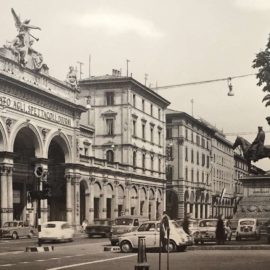
- Bologna, Piazza Garibaldi, 1960s
-
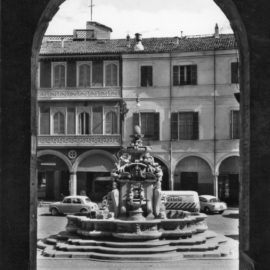
- Cesena, Masini Fountain, 1964
-
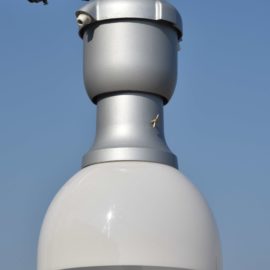
- Suspension road lighting framework, 1970
-
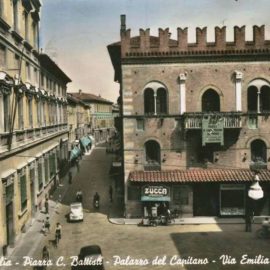
- Reggio Emilia, Piazza C. Battisti, 1960
Tubular steel lamp supports
This is the most common type among lights on poles. The steel supports, with an understated line, feature smooth and tapered surfaces. They mainly have discharge lamps (fluorescent tubes or bulbs) fitted, placed inside luminaires which, after the research, we grouped together in four main categories: “mushroom lanterns”, cylindrical, spherical or polygonal diffusers.
-
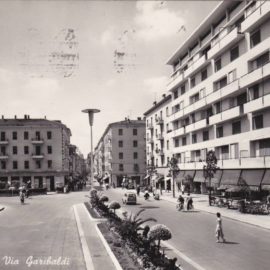
- Parma, Via Garibaldi, 1956
-
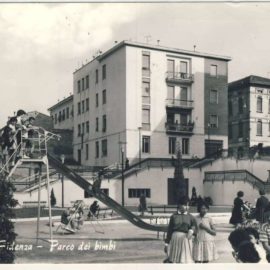
- Fidenza 1960s
-
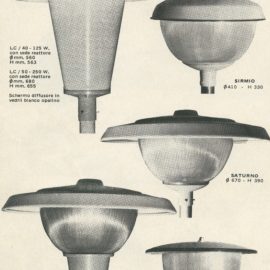
- Lamp post diffusers 1970
-
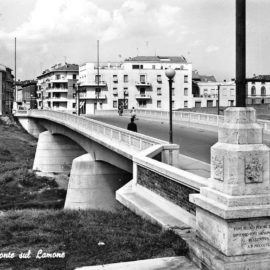
- Faenza, Bridge over the Lamone River, 1965
-
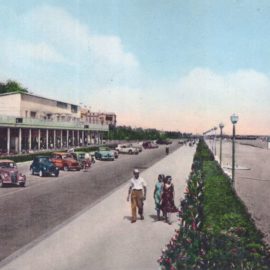
- Rimini Promenade 1950s
Tubular steel with one or more arms
Often of considerable height, these poles support one or more arms made both in steel, in this way forming the continuation, the extension of the standard, and in different materials including aluminium, popular on account of its well-known features of lightness. Placed along roads with vehicle traffic and in large squares, they use above all high-pressure sodium vapour lamps with open or closed optics. This type can be used for supporting simultaneously also transmission cables and those for the distribution of electrical energy.
-
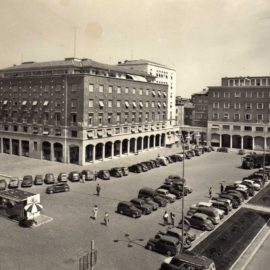
- Modena, Piazza Matteotti, 1955
-
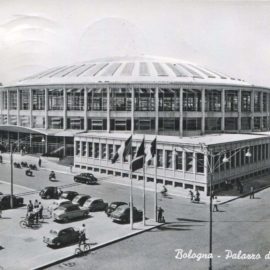
- Bologna, Sportcentre (PalaDozza), 1960 c.
-
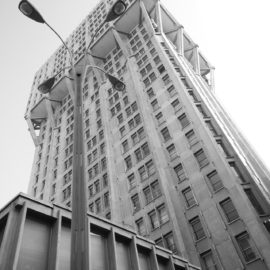
- Milan, the Torre Velasca and one of the lamp posts designed by the firm BBPR
-
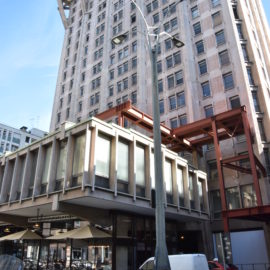
- The lamp post in Piazza Velasca today
-
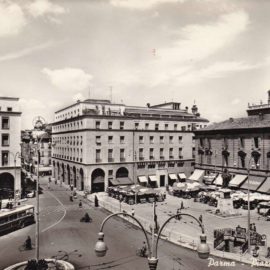
- Parma, Piazza Garibaldi, end of the 1950s
-
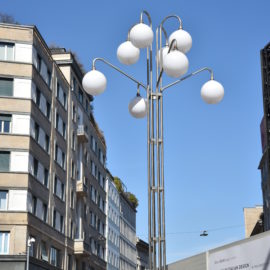
- Milan, one of the lamp posts in Piazza San Babila, today.
-
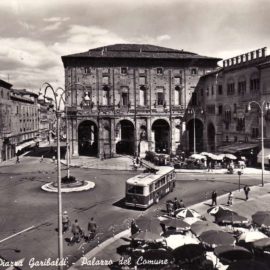
- Parma, Piazza Garibaldi, 1958
-
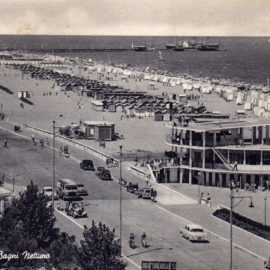
- Rimini, Bagni Nettuno beach facilities, 1956.
