Naples and the Gulf road
by Fondazione NeriThe idea of a new road linking the eastern and western parts of the city of Naples has represented, right from the second half of the nineteenth century, one of most debated and recurring themes, up to 1925 when the stagnant situation in which the matter had fallen offered the fascist government an opportunity for demonstrating its efficiency.
Without the outcomes being known of three competitions, held with the actual aim of finding the most suitable solution, a project took shape that aimed at radically transforming a section of the famous promenade, between Piazza del Plebiscito and Castel Nuovo, by creating a new road, the so-called Via Litoranea. A project which moves away from the “cleaning-up” vision of urban regeneration, previously taken into consideration, and which imposed instead a more modern and functional idea of the city.
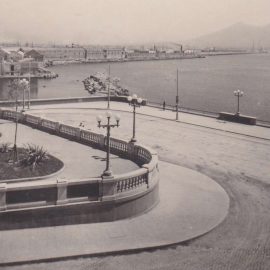
The route, 860 metres long, starts from Via Nazario Sauro and descends to the level of the wharf until it touches a new garden designed near the Molosiglio. It then continues parallel to the southern front of Palazzo Reale as far as the basin, passing between the latter and the Bourbon bastion, flanking Castel Nuovo, along the Beverello calata, until finally reaching Piazza Municipio.
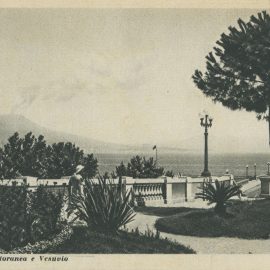
The new road was intended both for vehicle and pedestrian traffic, being equipped with side pavements and balustrades bordering green spaces, flowerbeds with flowers and plants for the walk. On these balustrades it was decided to install small cast iron posts to support a “T” shaped top with three globes in opaline glass installed. Apart from this top part, designed ad hoc for this specific context, the use or rather the readapting was highly probable of posts cast by the Pignone Florentine foundry already previously used for lighting other areas of Naples.
Three period postcards (dating from the Thirties), housed in the archive of Fondazione Neri, allow documentation of these examples of decoration for the elegant coastal road.