Magic! The pipe is weldless!
byAn object which almost goes unnoticed, but which still today plays a very important role in several areas, from oil extraction systems to gas pipelines, from water supply systems to buildings, from industry to infrastructure and up to street furniture. The weldless steel pipe was invented at the end of the nineteenth century by the Mannesmann brothers, enabling the production of structures able to resist high mechanical stresses and pressures.
Aside from the type of steel used, it offers excellent guarantees of compactness due to the fact of being made up of a single part. Pipes previously, above all in iron and cast iron, were instead produced in sections of various shapes and sizes which then had to be joined by attachment with rivets or welds, techniques which were often found to be unsatisfactory to the extent that the pipes assembled in this way were often subject to deformation.
The Mannesmann process consists of two main phases: production of the pipe and “pilgrim step” rolling. In the first, the solid steel bar is heated in the furnace and fed into the rolling mill where it passes between two rotating cylinders which compress it until a longitudinal cavity is formed in its interior. In this way the steel pipe is obtained, with a length considerably greater than the original bar. In the second phase a mandrel (component able to transfer rotation to the workpiece) is inserted inside the pipe which pushes it between two cylinders, one on top of the other and rotating in opposite directions. The cylinders press on the pipe, exerting at each turn a force which rolls it. After this second phase the pipe reaches a length from 5 to 10 times greater than the original pipe.
With this technique weldless steel pipes can be obtained today that are up to 70 cm in diameter and with a length of 15 m and even 30 m for pipes with diameter of 40 cm. Use of this material in street furniture reached a peak at the end of the Second World War. In the 50s and 60s in particular many tubular steel posts for public lighting replaced the previous ones in cast iron in town and city centres and became the prime choice in installations concerning the new districts and the growing suburban areas.
As well as the advantages mentioned above, this type of lamp post is faster to produce and therefore also more economical. Finally not even the style aspect is to be overlooked. The smooth and discreet surfaces reference in fact the minimalist style, undisputed key feature in the radical change on the artistic scene in the Sixties.

-
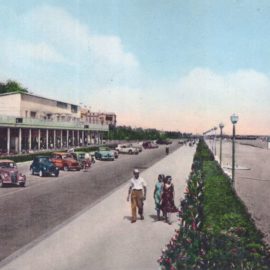
- Rimini Promenade 1950s
